


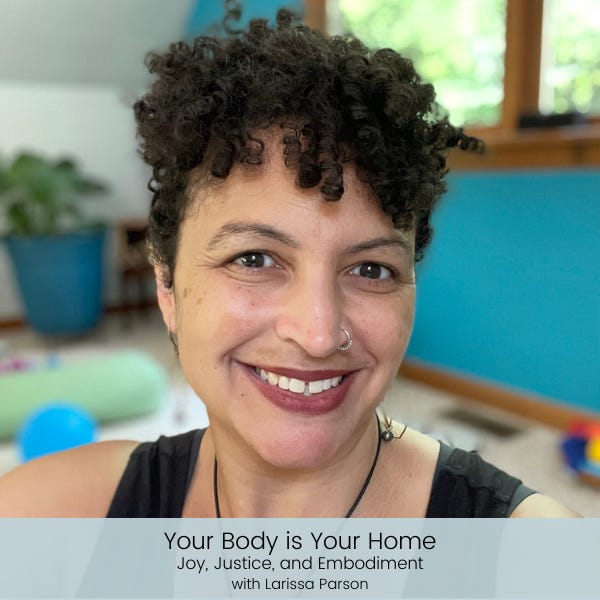
Your Body is Your Home | Episode 35
Description
Larissa is a queer, cis, biracial, Black movement teacher and mom to twins. She teaches intelligent movement strategies that help you feel connected, curious, and joyful in your body, and specializes in core & pelvic floor dysfunction. She is an ardent believer in the idea that connecting to your body is a pathway to joy, and joy is a pathway to justice and liberation.
This episode we discuss
* learning to sense joy and the full range of human emotion in your body
* reestablishing a connection to the pelvic floor
* the benefits of seeing a pelvic physical therapist
* freedom and clarity that comes with middle age
* living at multiple identity intersections and cultivating friendships
Episode Resources
Body Liberation for All Theme
They might try to put you in a box, tell them that you don't accept when the world is tripping out tell them that you love yourself. Hey, Hey, smile on them. Live your life just like you like it
It’s your party negativity is not invited. For my queer folks, for my trans, people of color, let your voice be heard. Look in the mirror and say that it's time to put me first. You were born to win. Head up high with confidence. This show is for everyone. So, I thank you for tuning in. Let's go.
This transcript was generated with the help of AI. Becoming a supporting member helps us improve accessibility and pay equitable wages for things like human transcription.
Dalia: This is so exciting. It's been forever since I've recorded an episode. Originally, I said I was just going to take a couple of months off. Mm-hmm. to just get my life in order, post covid and post finishing the book. And it is month six. And I'm not entirely sure when I'm gonna release this one, but I am excited to be recording again. I know that season two is gonna start the 1st of January and honoring rest and really liberating myself from that need to be productive all the time. I realized that I only wanted to podcast once a month.
It just felt so right in my entire body. Yes. And when I was looking at what you do, when we first met, it was at the Together Thriving conference. Yes, yes. And then you were talking about pelvic floor health. So, I thought your focus was on. Reproductive wellness. Mm-hmm. and that part of the body for people born with a uterus.
Right. And didn't realize that it's so much more than that, that it's embodiment work. When I was looking at your site and it talked about embodying joy, but also embodying justice, that really struck me because I realized I wasn't even sure what. Justice might feel like in the body. I'm just now getting to the point where I could feel in my body that podcasting once a month was a hell yes.
Per my entire body. Yeah. But there's still some things I think I wouldn't even recognize. So why do you lead with that on your site?
Larissa: That's such a good question. You know, so I was and still am really interested in and focused on doing core and pelvic floor rehab work. It's one of the things that. I love nerding out about hardcore, but what I found was, this is like the most circuitous way to get to the answer to your question, by the way.
But what I found was that the more that I worked with people and the more that we kind of went on this pelvic floor journey together, where they started developing more awareness of their bodies' habits and patterns, and the more work I was doing with the folks, the more I got to this like realization that.
At the bottom, if you imagine the work we're doing as a cereal box, or like a box of Cracker Jack or something, there's like this prize in the bottom of the box and that is like this body liberation stuff. Mm-hmm. And I decided I was tired of having it be the secret. Mm. I was tired of it being like the thing that we got to at the end of a series or after working together for a few months.
And I really wanted to lead with it because I feel very strongly. Like, like I say on my website, that the body is a home for joy because we feel joy in our bodies and our bodies are homes for justice because we feel injustice acted on our bodies and we feel it with our bodies, and we feel it in the ways that we make choices about our bodies.
And so, if we can get in more touch with our bodies, if we can really embody our bodies, feel like our bodies are our homes, then our bodies become a site for justice instead of injustice.
Dalia: I love that you lead with it, and everything resonates. I felt like the copy was so beautiful the way you phrased everything.
Thank you. But then I also thought, I am kind of a rare. Not that I'm a special snowflake, even though low key, I do think that I am, I felt like with my own messaging where I struggled the most was trying to give people something they needed that they would recognize. Yeah. So, with the pelvic floor, people recognized they need that.
Cuz when I first heard that, I was like, Yes, I'm gonna be front and center for your presentation so I can figure out how. Stop pee when I laugh. I used to think that was only for people who'd had children, and now I realize it's for like literally everybody. Uhhuh as you get a little older and no one's told you like what to do to strengthen your pelvic floor.
Yeah, but then when you talk about the end goal, which, because I kind of think that way, what I wanna do for people is make them feel comfortable in their bodies and confident that their life is best led by them in every single way. But when you say that I think a lot of people don't know whether or not they need that.
I know even in the coaching contain, we weren't in this program together, but we are active in the same group. Yeah. So, one of the coaches that I've had, when I went to her, I did not know I needed what she actually offers. Yes. But she's such a master of marketing she presented something that I thought I needed, but what I needed, like you said, was at the bottom of the cereal another prize. It was confidence, it was mindset. But I never would've signed up for anyone who said they did mindset coaching. I would've been like, Oh, for what? Sounds impractical. So, have you had any issues finding your ideal person when you changed your marketing?
Larissa: That's such an interesting question because I'm kind of in this in between space where I've changed the copy on my website and I'm still also teaching a lot of the same stuff and marketing it very in a very similar way. So, I would say I haven't really had a hard time finding folks to work with. And the folks who really wanna do this work who show up in my membership, for example, are really interested in the way that we're doing this together.
When we are working together in that space at least, we have coaching conversations where we talk about all those little things that are going on in our lives that are taking away our sense of joy or adding to our sense of joy. But then we also do movement practices. So, we're really doing this embodiment work together and really experiencing, Okay the, the question that I think a lot of people can't answer all the time is, what does joy feel like in your body? Like what does joy feel like? Everyday? Joy. Not like, not like I just felt the best massage of my life.
Dalia: Well, see, I wondered about that. When you say everyday joy, that's really Yeah. Helpful because I could definitely think about periods of like transcendent period.
Yeah. And it doesn't have to be anything major. It's usually. Any kind of dancing exercise. It might happen if I do it for long enough. But a friend of mine I think saw, maybe it was your post asking like, what does, do I feel like in your body or someone else make, but I'm pretty sure it was you. And they said, oh my goodness, I don't know.
And that was the first time they'd really thought about that. And I thought, Oh no, that’s a little heartbreaking. Yeah. And I feel like they are a joyful person, but they, like so many of us, folks of color, spend a lot of time thinking about survival. Yep. And not thinking about joy. Yes. Yes. So where do you start with that?
If you don't know what joy feels like in your body, and why do we need to know?
Larissa: So, I usually start with something, actually, I think I wanna answer the second question first. I was gonna say, I have this thing we start with, but let's answer the second question first. So, like, why do we need to know what joy feels like in our body?
Because life is hard and because every system of oppression wants to steal our joy and so, I see joy as being revolutionary, not unlike rest. Rest comes along with joy. Like they, they go together. They're very important parts of the whole picture. We need to know what joy feels like because we know what struggle feels like.
Mm. We know what suffering feels like. We know what sadness, anger, frustration. We know what all of those things feel like and to not be able to also access things like joy, pleasure, delight. That is not okay. That's not a full spectrum of feelings for a human. And humans need to feel all the feelings. So, it doesn't mean that you're never angry if you, you're living a joyful, delighted life.
It just means that when you're angry, you know that you have reasons for your anger a lot of the time, and that the feeling





 United States
